Beha'alotcha – Torah with Joseph
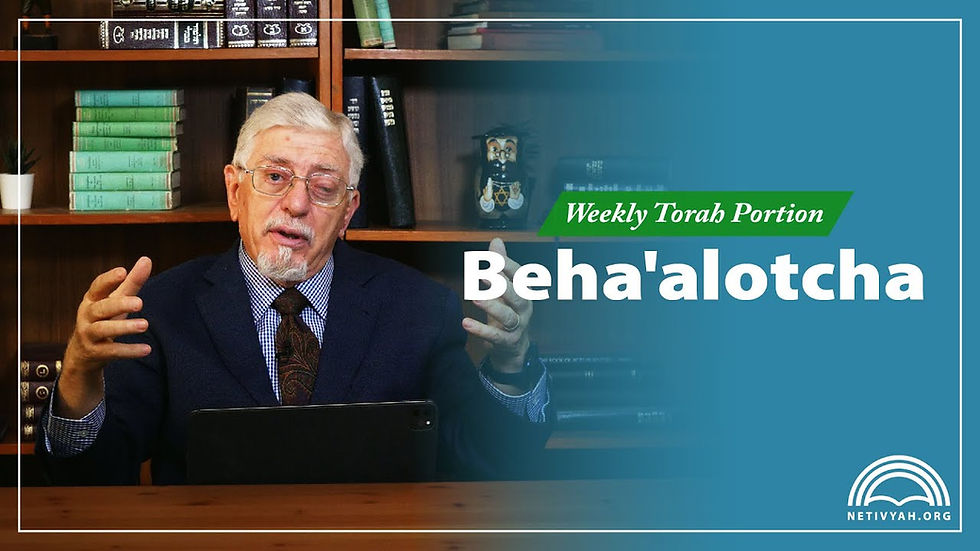
Table of Contents
Read the transcript below, or watch a video of the teaching by Joseph Shulam.
Shalom. My name is Joseph Shulam, and in partnership with Brad TV, we are following the weekly portion that is read in every synagogue around the world this week.
This Sabbath, we are going to start talking about a portion that’s called Beha’alotecha, which means “when you set up the Menorah”, the candelabra in the temple. We have instructions of how to build the candelabra, that is the shape of it. Our reading starts from chapter eight, verse one, and ends in chapter 12, verse 16 of the book of Numbers. From the Prophets, we are reading from Zechariah chapter two, verse 10 to chapter four, verse seven; and from the New Testament, we read from Luke chapter 10, from verse one to 24.
Now, the candelabra has seven lamp stands, a central lamp stand, and each side three lamp stands, which makes it a total of seven. Now, in the New Testament that candelabra plays an important role. The book of Revelation, from chapter one, is written to the seven churches in Asia Minor. Each church is one of those seven candles, and together, they make the candelabra. That’s why it is important for us today to understand what that candelabra was like, that Menorah, in Hebrew.
First of all, the first thing that we read here in the book of Numbers is that the candelabra was made from one piece of gold that was hammered into shape.
Also, it is very interesting for us who know the book of Revelation, and received the book of Revelation as God’s revelation for the church, and for the world, to understand the teaching about the end of the world, and what will precede the end of the world. And the reason that this is important for us to understand is this; the seven churches of Asia Minor, each one of them had its own problems, its own sin, its own challenges, its own need for repentance, and regrouping of the people, and the work of the holy spirit in holiness, and each one had its own sin.
Each one of those seven churches of Asia Minor had their own sin. And here you have the secret of why John, in Revelation, calls those seven churches candles, seven candles, a candelabra of seven candles, because in the Torah, we learned that this candelabra was made from one piece of gold, hammered. If I translate the hammered with another word; put through the mill, put through difficulties, going through persecution, having internal problems, hammered. That’s the imagery that John is trying to get to when he is talking about these seven churches of Asia Minor.
Now here, the tabernacle is about to open, and to become functional, and we have the first thing that is mentioned, in our portion, verse, chapter eight of the book of Numbers, is that Moses spoke to Aaron, and said to Aaron, “When you arrange the lamps, the seven lamps shall give light in front of the lampstand.” That candelabra was supposed to be on 24/7 all the time. It gave light inside the tent of meeting, inside the tabernacle, that had no windows. Remember that the tabernacle had no windows.
So, the candelabra gave the light inside the tabernacle, inside the holy space of the tabernacle. And in verse four of chapter eight of Numbers, we read through five. “Now, this is the workmanship of the lampstand it was hammered gold from its shaft to its flowers. It was hammered work according to the pattern which the Lord had shown Moses, so he made the lampstand.”
What did we learn from this? We learned that when Moses was up on the mountain with God, and God showed Moses the blueprint, at least the blueprint, maybe a maquette, maybe a model of the tabernacle, a heavenly model of the tabernacle, there was also a model of the candelabra. Now Moses and the children of Israel reproduced that heavenly candelabra on Earth from gold, a copy of what he saw in the heavenly tabernacle.
Now that the candelabra is in place, comes the role of the dedication of the Levites. The first thing in the dedication that they had to do in verse six of chapter eight of Numbers, was to be cleansed, purified, ceremonially, of course. I mean, they took baths, I’m sure, before that occasion, but they had to be cleansed ceremonially, to be immersed. Their clothing had to be purified and washed. They had to offer sacrifices for their atonement, and for their dedication to the service of the Lord.
In verse nine of chapter eight, we find this word that is translated in English. “You shall bring the Levites before the tabernacle of meeting,” but the word for bring the Levites, or bring them close is the same word as sacrifice. The priest, the cohanim were the children of Aaron.
The Levites were the rest of the people of the tribe of Levi, and they had to be purified before they entered the service of the Lord in the tabernacle. They had to wash their clothes, immerse themself in water. Moses and Aaron, earlier we read in the book of Numbers, they had to anoint them after they were purified. The anointing was of the right-hand thumb of the right ear and the right feet. That’s how the anointing of the Levites was; it was both with blood of the sacrifice, and with oil. Why?
A servant of God has to hear from God, has to do God’s work with his hands, and he has to walk on the path of God. That’s why the dedication was this way, and the Levites got dedicated, and now they had to lay hands on the heads of their sacrifices, on the head of the bull, on the head of the goats and the sheep. Before they slaughtered them, they laid hands on them, and they had the wave offering of the bodies of, and I’m sure not the bull, but maybe the bull too, I don’t know, the calves, and the other animals that were offered on that day. They had to be lifted up. That’s what the wave offering means, lifted up before the Lord, and then offered on the altar.
And then we see in our portion, a very interesting thing that people don’t think much about. It says every first born in Israel to an Israelite mother had to be given to the Lord, dedicated to the Lord. Every first born of the Levites, in verse 16, had to be redeemed. Why? The text tells us. I’m going to read chapter eight verse 16 and 17 of the book of Numbers. It’s a very, very important thing. “For they,” I’m going to read from verse 15 so they get the context. “After the Levites shall go into service the tabernacle of meeting, so you shall cleanse them, and offer them like a wave offering, for they are wholly given to me from among the children of Israel. I have taken them for myself instead of all who opened the womb, the first born of all the children of Israel, for all the first born among the children of Israel are mine, both man and beast. On the day that I struck all the first born of the land of Egypt, I sanctified them to myself.”
In other words, the death of the first born in the 10th plague before the Exodus of Egypt, those first born of the Egyptians have caused God, because he saved the first born of the Israelites, to have the first born of the Israel belonging to God. In other words, they redeemed the death of the firstborn of Egypt.
It says that very clearly in verse 18. “I have taken the Levites instead of all the firstborn of the children of Israel, and have given the Levites a gift to Aaron and his sons from among children of Israel to do the work of the children of Israel in the tabernacle of meeting, and to make atonement for the children of Israel, that there be no plague among the children of Israel when the children of Israel come near the sanctuary.”
In other words, they had to be redeemed, the first born of the Egyptians that died, and they were, the first born of the Levites redeemed the first born of the children of Israel.
How did they redeem them? So, they had to serve God as Levites in the tabernacle. It’s an interesting thing, this whole thing of redemption. We talk about getting saved. Getting saved in the normative evangelical Christian thinking has to do with the judgment day. You live, and you then die, and because you got saved, you will spend eternity in heaven with the saints, with God, with Jesus with the apostles, with the angels.
But the redemption here is not in order to go to heaven. It’s in order to serve God down here on Earth. These Levites that were redeemed by the firstborn were supposed to serve God. They were not waiting for heaven. They were dedicated to serve down here on Earth during their lifetime.
What happens to them after that would be like everybody else that is saved and redeemed by the blood of the lamb, by the lamb of God that takes away the sins of the world, Yeshua, our Messiah. But what is interesting here is the bookkeeping that God keeps. I killed those children of the Egyptians in the 10th plague, to deliver the children of Israel from slavery.
But you guys are not getting it free. You are going to have to dedicate your first born, the Levites, to serve in the tabernacle as redeeming those children of Israel, and those first born of the Egyptians that died in the 10th plague.
Very interesting. I find it extremely interesting. First of all, I find that we, the disciples of Yeshua, in the world, now have a calling, a partnership. We have an obligation to serve God if we’re Levites. For example, my family’s from the tribe of Levi, both sides of the family, my father’s side and my mother’s side. And if we had a temple in Jerusalem, I would be called to serve as a Levite. We don’t have a temple. We haven’t had a temple since 70 AD when the Romans tore down Jerusalem, and tore down the temple, and burned it to ashes.
But the concept that I, and you, my Christian brothers, and sisters, and Jewish disciples of Yeshua, must understand, is that our redemption, yes, it is by grace, but it carries with it obligations. Those Levites, because they were Levites that were killed by the 10th plague, by God’s plague, now have to serve in the tabernacle. They’re not free to do whatever they want to. They have to serve in the tabernacle, the service of God as a redemptive service for the Egyptian firstborn that died, and for the first born of Israel that are not Levites.
So, this is a very interesting concept. But of course, they had to be immersed in water. They had to be purified by washing their clothes, by wearing special clothes, by having special duties. And it’s interesting that the language that is used here is military language. Verse 23 of chapter eight of Numbers, “The Lord spoke to Moses saying, ‘This is what pertains to the Levites, from 25 years old and above, one may enter to perform the service in the work of the tabernacle of meeting.’”
Now, a 25-year-old man, probably already married, has children, maybe had already made his fortune, maybe he’s built his house, joins the army. He’s out to perform the service of the work of the tabernacle of meeting, and at the age of 50, he retires. “They must cease performing this work, and shall work no more. They may minister with their brethren in the tabernacle of meeting to attend needs, but they themselves shall do no work that the Levites do, regarding their duties.”
In other words, between the age of 25 and age of 50, they’re like in the army. Those first born of the Levites, they’re like in the army, and they are serving the tabernacle. At the age of 50, they can stop their service at the tabernacle, and they can tend to their own business, or they can also help in the tabernacle, but not, it’s not as if they were in their duty.
Now, all this happens, all what we read is at the foot of Mount Sinai before, after they finished building the tabernacle, and before they start marching, 38 years before they entered the land. All this has been prepared in two years. They left Egypt. They received the law in Mount Sinai. They built the golden calf in Mount Sinai. As a result of that, they built the tabernacle, all donations, all contributions. Women took their earrings off, their bracelets, their gold, their wealth.
They gave it to the building of the Lord, silver, and gold, and precious stones that don’t exist in Sinai, they got from the Egyptians. We know the Egyptians had a lot of jewelry, a lot of precious stones. You see it in the Egyptian museum in Cairo, all the jewelry. The mummies were dressed with gold, and gold masks, and so they had stuff. They gave it all to the building of the tabernacle, and now they’re packed.
They have their jobs. Each one knows what he is supposed to do, and they start marching into the wilderness.
But in chapter nine of our portion, Passover comes. I’m reading from chapter nine, verse three. Now listen, “On the 14th day of this month, the month of Nisan, the first month of the year.” And the biblical Old Testament says, “At twilight, you shall keep it in its appointed time, according to its rights and ceremonies, you shall keep it.” So, Moses told the children of Israel they should keep the Passover, and keep the Passover on the 14th day of the first month, the month Nisan. That’s the first month in the biblical calendar. At twilight in the wilderness of Sinai, according to all that the Lord commanded Moses.
So, the children of Israel did whatever they were commanded. You know, this is the first time that the Passover is kept outside of Egypt as a feast, yeah? And you would be surprised that the children of Israel, that had the Torah that their grandfathers left Egypt, didn’t keep those feasts as much as they should have.
We find out later in the Prophets that they didn’t keep the feast of Passover until quite late, the time of Josiah. And we find out that they didn’t keep the feast of of Sukkot, Tabernacles, until quite late; until the days of Ezra and Nehemiah in the book of Nehemiah, chapter eight and nine, they had these feasts, they didn’t keep them.
And we are living in a time when our brothers and sisters around the world are beginning to wake up, and understand the significance of these feasts. The way Paul puts it, all these feasts, the Sabbath, and the dietary laws, and the new moons, are a shadow of the things to come in Christ, in the Messiah. So, we’ll talk about this some other time.
Our time is short now for talking about what’s happening in the New Testament with the book of Paul’s letters, and especially in the book of Colossians chapter two, verse 16, but you should read it, and find out if it is important or not important according to the apostle Paul, for us as disciples of Yeshua, Jews and non-Jews, to look at the shadow of the things that are to come?
It is prophetic; and that includes the Sabbath, the new moon, the feasts, and the appointed days of the Lord. All of this is prophetic about the coming of the Messiah himself.
May God bless you all. Keep reading, and keep studying, and don’t be shy. If you have questions, I will do my best to answer them if I get them.
God bless all of you, and Shabbat Shalom.
Get Downloads
File Title
Add paragraph text. Click “Edit Text” to update the font, size and more. To change and reuse text themes, go to Site Styles.
Add paragraph text. Click “Edit Text” to update the font, size and more. To change and reuse text themes, go to Site Styles.

Joseph Shulam
Founder
Joseph is the pioneering founder of Netivyah, one of Israel’s first official Messianic non-profits. Dedicated to restoring the Jewish roots of the faith, he has authored numerous books and lectured globally for over 50 years.
Glossary
Altar (mizbe'ach, מִזְבֵּחַ) refers to the sacred place where offerings were presented to God.
Holiness (kedushah, קְדֻשָּׁה) means being pure, set apart, and living according to God's will as He instructed in His Word
Levi (לֵוִי) is one of the twelve tribes of Israel, from which the priests and Levites came.
Levite (לֵוִי) refers to a member of the tribe of Levi, set apart for service connected to the sanctuary and worship.
Menorah (מְנוֹרָה) often refers to the seven-branched lampstand of the Tabernacle and Temple, symbolizing God’s light and presence.
Nisan (נִיסָן) is the first month of the biblical calendar, the month of Passover and Israel’s redemption from Egypt.
Redemption (ge'ulah, גְּאֻלָּה) means being rescued or bought back, and refers to God delivering His people from sin, slavery, and death.
Shabbat (שַׁבָּת) refers to the seventh day, the Sabbath, set apart by God as a holy day of rest, worship, and delight (see Genesis 2:1-3).
Shalom (שָׁלוֹם) means peace and completeness, and is often used as a greeting in Israel, both when meeting and parting.
Sukkot (סֻכּוֹת) means “booths” or “tabernacles” and refers to the biblical festival remembering Israel’s wilderness journey and God’s faithful presence and provision.
Synagogue (beit knesset בֵּית כְּנֶסֶת) is a Jewish place of prayer, study, and community gathering.
Tabernacle (mishkan, מִשְׁכָּן) refers to the portable sanctuary where God’s presence dwelt among Israel in the wilderness.
Torah (תּוֹרָה) means “instruction” or “teaching” and often refers especially to the Five Books of Moses. Psalm 119:1 reminds us that those who walk in God's Torah are blessed.
Yeshua (יֵשׁוּעַ) is the Hebrew name of Jesus, meaning "salvation"
More Topics
More For You

When the Burden Breaks the Leader
Even Moses reached his breaking point, but God’s answer was not shame. It was shared anointing, humble leadership, and grace under attack.
Article

Beha'alotcha – Once Upon a Week
In Beha'alotcha, the Menorah teaches us to turn light inward first; humility, love, and self-reflection in Messiah then shine outward today.
Video
