When the Burden Breaks the Leader

The Collapse of the Greatest Leader in History
Immediately after the children of Israel begin their march from Mount Sinai, they start complaining. They complain about the manna. They weep for meat. And Moses — the greatest leader in Israel's history — collapses. What most people miss is the context: Jethro, Moses' father-in-law, had left the camp. Moses now had no one to lean on and no one to encourage him.
Here is what Moses says to God in Numbers 11:11-15:
"Why have You afflicted Your servant? And why have I not found favor in Your sight, that You have laid the burden of all these people on me? Did I conceive all these people? Did I beget them, that You should say to me, 'Carry them in your bosom, as a guardian carries a nursing child,' to the land which You swore to their fathers? Where am I to get meat to give to all these people? For they weep all over me, saying, 'Give us meat, that we may eat.' I am not able to bear all these people alone, because the burden is too heavy for me. If You treat me like this, please kill me here and now — if I have found favor in Your sight — and do not let me see my wretchedness!" — Numbers 11:11-15 [NKJV]
Moses is asking God to kill him. Imagine that. Leadership that is sincere and caring can be a true burden that at times is hard to sustain.
God's Solution — Share the Anointing
God does not scold Moses for his breakdown. He tells Moses to gather 70 elders of the people and bring them to the Tabernacle, and share his anointing with them. A great leader, no matter how strong and powerful, cannot lead alone for a sustained period of time. He must learn to share his anointing and gifting with other qualified personnel. The 70 elders receive the commission and stand side by side with Moses to lead the people of Israel in the wilderness.
But almost immediately after the elders are appointed, Miriam and Aaron — Moses' own sister and brother — wake up and feel that they too deserve the same position as Moses. And what do they do? Note the pattern: the first thing they attack is Moses' personal life. He married an Ethiopian woman. The second thing they attack is the exclusivity of Moses as leader. Miriam's claim was very typical: "We are also leaders! Who made you a Sultan here? We have the same abilities. We too hear the word of the Lord! Why are you, our little brother, so full of yourself? We too are qualified to lead just like you."
Here is the full account from Numbers 12:1-13:
"Then Miriam and Aaron spoke against Moses because of the Ethiopian woman whom he had married; for he had married an Ethiopian woman. So they said, 'Has the Lord indeed spoken only through Moses? Has He not spoken through us also?' And the Lord heard it. (Now the man Moses was very humble, more than all men who were on the face of the earth.) Suddenly the Lord said to Moses, Aaron, and Miriam, 'Come out, you three, to the tabernacle of meeting!' So the three came out. Then the Lord came down in the pillar of cloud and stood in the door of the tabernacle, and called Aaron and Miriam. And they both went forward. Then He said, 'Hear now My words: If there is a prophet among you, I, the Lord, make Myself known to him in a vision; I speak to him in a dream. Not so with My servant Moses; He is faithful in all My house. I speak with him face to face, Even plainly, and not in dark sayings; And he sees the form of the Lord. Why then were you not afraid to speak against My servant Moses?' So the anger of the Lord was aroused against them, and He departed. And when the cloud departed from above the tabernacle, suddenly Miriam became leprous, as white as snow. Then Aaron turned toward Miriam, and there she was, a leper. So Aaron said to Moses, 'Oh, my lord! Please do not lay this sin on us, in which we have done foolishly and in which we have sinned.' So Moses cried out to the Lord, saying, 'Please heal her, O God, I pray!'" — Numbers 12:1-13 [NKJV]
What Comes Out of Your Mouth
Yeshua learned from this story about Moses and Miriam that if you speak evil and act presumptuously you become more impure than if you eat without washing your hands, or even more impure than if you eat lobster, shrimps, or bacon. What comes out of your mouth is more defiling than what goes into your mouth. This is taken directly from this story of Moses, Miriam, and Aaron. Leprosy is one of the most defiling and impure things in the Bible.
Leadership in God's kingdom is not a private professional job. It is a calling from God, and leaders have to allow God to demonstrate His power and His approval of their leadership. Even when there is dissatisfaction in the camp, and even if it comes from insiders and even family, the graciousness of God's love and grace has to be the most visible quality of the leader. Let us all learn leadership from Moses — and also learn to share the anointing and inspiration with the other qualified men and women in our congregations and ministries.
Get Downloads
File Title
Add paragraph text. Click “Edit Text” to update the font, size and more. To change and reuse text themes, go to Site Styles.
Add paragraph text. Click “Edit Text” to update the font, size and more. To change and reuse text themes, go to Site Styles.

Joseph Shulam
Founder
Joseph is the pioneering founder of Netivyah, one of Israel’s first official Messianic non-profits. Dedicated to restoring the Jewish roots of the faith, he has authored numerous books and lectured globally for over 50 years.
Glossary
Manna (מָן) refers to the miraculous bread-like food God provided for Israel in the wilderness, teaching His people to depend on His daily provision.
Tabernacle (mishkan, מִשְׁכָּן) refers to the portable sanctuary where God’s presence dwelt among Israel in the wilderness.
Yeshua (יֵשׁוּעַ) is the Hebrew name of Jesus, meaning "salvation"
More Topics
More For You

Doing Business in the Middle East — Lessons From Abraham and Ephron
In Middle Eastern business, honor, humility, and clarity matter more than bargains. Abraham teaches: pay fully, stay free, and build trust for generations.
Article
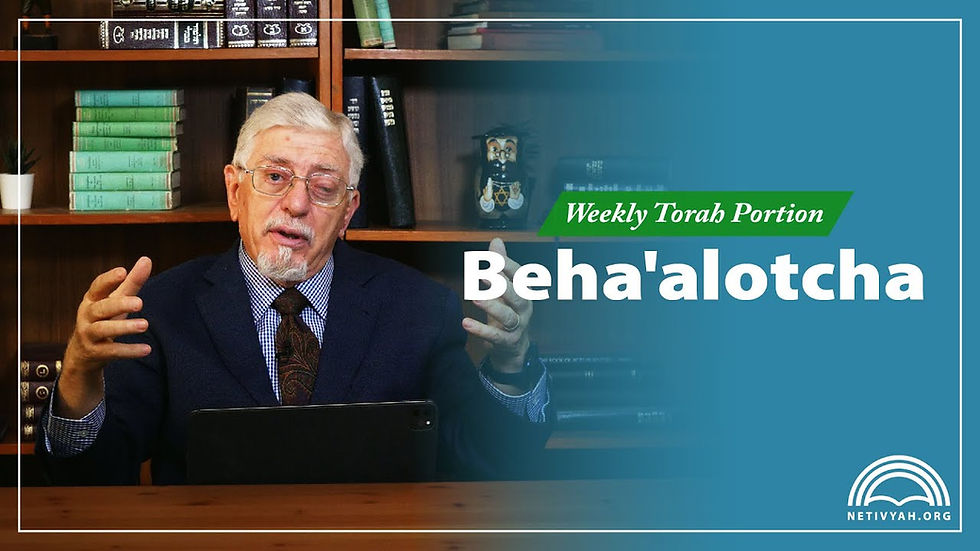
Beha'alotcha – Torah with Joseph
Beha'alotcha explores the menorah’s light, the cost of redemption, and why being chosen by God means serving, not escaping hardship or responsibility.
Video
.png)