Beha'alotcha – Once Upon a Week

Table of Contents
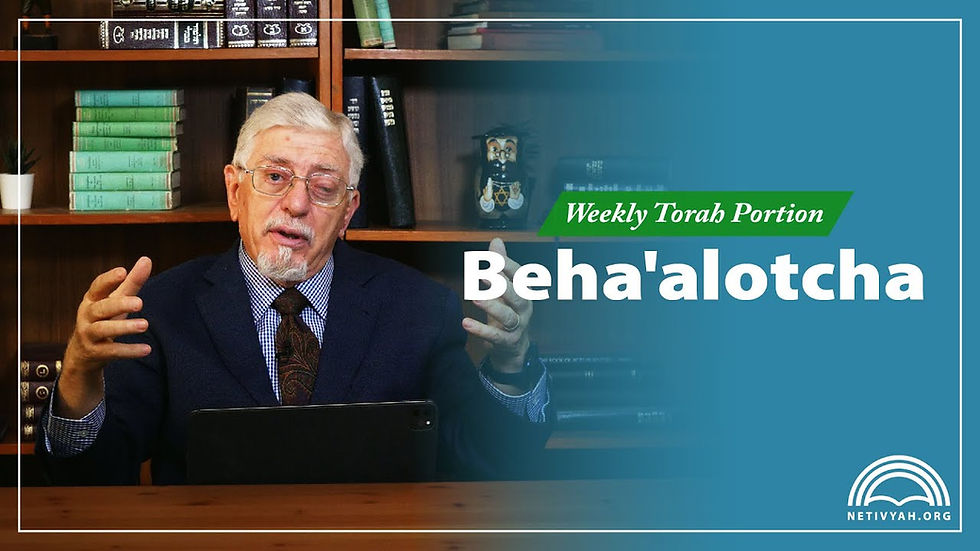
Read the transcript below, or watch a video of the teaching by Yehuda Bachana.
Behaalotecha means ‘when you set up’:
“Speak to Aaron and say to him, ‘When you set up the lamps, see that all seven light up the area in front of the lampstand.’” (Numbers 8:2)
The lamps of the Temple Menorah faced inwards, pointing towards the central lamp. According to the Midrash interpretation of this text, one looks at these lamps and compares oneself to them. First and foremost, our own light should be pointed inwards. We must deal with ourself first, especially when we criticize.
In my opinion, this idea is foundational of Yeshua’s teaching and of the New Testament. The spirit of our faith requires, that instead of pointing out all the wrongs in others, we should rather reflect upon all the good qualities I myself have, thanks to Yeshua and to my faith. When our lamps face inwards, only then will we be able to light up the world, through the light of Messiah Yeshua, Who dwells within us.
The end of this Torah portion gives an example of light shining inwards. Let’s take a look at the interesting story of the three siblings, Miriam, Aaron and Moses. Miriam slanders Moses, as part of Aaron and her complaints about the gift of prophesy (chapter 12). They wonder if God only speaks to Moses and then conclude He also speaks to them. What really stands out is that, in spite of their complaints about Moses,
“Moses was a very humble man, more humble than anyone else on the face of the earth.” (Numbers 12:3)
Moses’ humility is visible in his refusal to defend himself by pointing out the wrongs in his siblings. Moses does not point to their slander nor to their jealousy, which obviously fills their hearts.
God explains to Aaron and Miriam that Moses is unlike the other prophets.:
“Listen to my words: ‘When there is a prophet among you, I, the Lord, reveal myself to them in visions, I speak to them in dreams. But this is not true of my servant Moses; he is faithful in all my house. With him I speak face to face, clearly and not in riddles; he sees the form of the Lord. Why then were you not afraid to speak against my servant Moses?’” (Numbers 12:6-8)
You see? God speaks with all the prophets through visions, dreams or riddles. With Moses, however, He speaks face-to-face. Here Moses’ humility stands out. It seems that those around Moses (including his own siblings) are unaware of the special relationship he has with God. We see Moses’ greatness also, and perhaps mainly, after Miriam receives her punishment. Miriam is punished with leprosy, which is sign of divine retribution. Is Moses glad about it, feeling she deserves it? Does he accept the fact that God punishes Miriam and then moves on? Moses does not, and cries out to God right away:
“Please, God, heal her!” (Verse 13)
Moses does not wish his sister to be harmed, even if she slandered him. Moses is filled with true love. Paul defines true love as:
“Love is patient, love is kind. It does not envy, it does not boast, it is not proud. It does not dishonor others, it is not self-seeking, it is not easily angered, it keeps no record of wrongs. Love does not delight in evil but rejoices with the truth. It always protects, always trusts, always hopes, always perseveres.” (1 Corinthians 13:4-7)
What happens when criticism does not begin inward, from self-reflection? What happens when we do not take responsibility? Bitterness takes control of our hearts, creating a great challenge for our leaders. Probably all throughout history, people were upset with their current leaders.
We tend to look back and miss leaders from the past, regardless if they were good or bad. Our memory is very short. We see the same phenomena in our Torah portion. Only two years have passed, and Israel already forgot their suffering in Egypt and seems to miss the goodness and prosperity of Egypt.
Today we look back at Moses the prophet, who spoke face-to-face with God. The leader who placed himself as a buffer between God’s wrath and the people. The leader who, with his own hands, or better said with his own spirit, his stubbornness and his love for the people of Israel, saved us. I wish we would have such a leader! Then what do the children of Israel complain about, time and again? Why do they, including his immediate family, constantly attack Moses?
The truth is that we love to sit comfortably on the sofa and criticize others. From our comfort zone, we confidently yell at soccer and basketball players: “Worst missed goal ever! Even I would score here!” We tend to blame others, because we skip the first step of self-criticism.
As human beings, we are selfish and place ourselves in the center, thinking that is what we deserve. Do you want to see change? It begins with me, and it does with you.Our Torah portion contains a famous blessing:
“Whenever the ark set out, Moses said, “Rise up, Lord! May your enemies be scattered; may your foes flee before you.” (Numbers 10:35)
What is this blessing? What kind of enemies does it refer to? Could it be about the ‘enemy within’? Those are not less harmful than the enemies outside. This line of thought is enforced by what follows immediately after the blessing: people start to complain, riot and cry. This all happens in a place called ‘Kivroth HaTa’avah’ (or: the graves of desire), named after the many graves of those killed in this riot. Israel’s internal struggles caused many casualties. And so, right after the riot, we read about the family riot led by Miriam and Aaron.
Next week we will study ‘Shelach Lecha’, where yet another rebellion of the nation of Israel, is followed by a 40-year long punishment of desert wandering till the entire generation dies. Then, which enemies are worse, those outside or within?
The people of Israel complain constantly to Moses. Those inner struggles mortally hurt the leadership and Moses. When facing enemies from the outside we are united, strong and motivated. Yet, when facing enemies from within, our morals crash and we fall into despair. How does Moses react?
“I cannot carry all these people by myself; the burden is too heavy for me. If this is how you are going to treat me, please go ahead and kill me” (Numbers 11:14-15)
Even our great leader Moses cannot bare constant outbursts and criticism, even if they are unfounded. That is why the lamps of the Menorah and the light of our life, should point inwards. We should ask ourselves: “Can I do better?” If the answer is positive, then get up and do it. Improve! Of course, if the answer is a ‘no’, we should at least support those who do, or try to do.
The Menorah became a central symbol of Israel and the Jewish people. As a matter of fact, the Menorah is the official emblem of Israel. The olive branches to the right and left, symbolize our aspiration for peace.
Simultaneously, they are based on Zechariah 4:
“He asked me, “What do you see?” I answered, “I see a solid gold lampstand with a bowl at the top and seven lamps on it, with seven channels to the lamps. Also, there are two olive trees by it, one on the right of the bowl and the other on its left.”
Text continues with a well-known verse from Zechariah 4:6
“Not by might nor by power, but by my Spirit,’ says the Lord Almighty.”
Paul explains his understanding of the phrase ‘not by man’s power, but by the spirit of the Lord’, as following:
“It does not, therefore, depend on human desire or effort, but on God’s mercy.” (Romans 9:16)
Meaning that salvation is a result of God’s mercy, and not of man’s power. An example can be found through the Exodus from Egypt. Israel was not saved because of its strength. Truly, even if they really wanted, they were unable to save themselves. Yet, God had mercy upon them, and saved Israel from Egypt with His mighty hand and His outstretched arm. Power belongs to God, not to man.
The history of Israel is the prototype to the very idea of redemption, the connection with God, and the Lord’s service. In the first part of our Torah portion, we continue to deal with the work of the Tabernacle and the Levites’ sanctification for their duties.
We notice that the chain of events, like the dedication of the Tabernacle and the sanctification of the Levites and priests, are similar to those described in Exodus. Let’s pay attention to the time mentioned in both books. The time stamp in the text in Exodus is mentioned in this manner:
“The tabernacle was set up on the first day of the first month in the second year.” (Exodus 40:17). Whereas, the time stamp in this Torah portion states that: “The Lord spoke to Moses in the Desert of Sinai in the first month of the second year after they came out of Egypt.” (Numbers 9:1).
This shows that we are talking about the same period of time.
Since the Exodus from Egypt is a prototype of redemption, the Torah describes the process of redemption of the Hebrew slaves and their transition into becoming the nation of Israel, at length and in great detail.
A large part of this process happens by means of a common project, namely the building of a house for God. At the dedication of the Temple, Solomon asks a rhetoric question: if the heavens are unable to contain God, how can a man build God’s house?
“But will God really dwell on earth? The heavens, even the highest heaven, cannot contain you. How much less this temple I have built!” (1 Kings 8:27)
When we skip the ‘boring parts’ of the Torah, like the instructions for building the Tabernacle, we miss out on the great and meaningful depth of the Word of God. It is important, but we just do not understand nor internalize the great meaning. For example, let’s take the story of creation, which is described in just a few verses that include the creation of the sun, stars, universe, earth, hills and valleys, sky and sea, the fish of the sea and the birds of the air, and:
“The wild animals according to their kinds, the livestock according to their kinds, and all the creatures that move along the ground according to their kinds.” (Genesis 1:25)
The entire creation is described in a handful of verses. On the contrary, the construction of the Tabernacle is lined out in the smallest details, chapter after chapter. This includes the size of each curtain, how many loops it must have, what material and what size every vessel should be made of. Everything is reported in great detail. For example,
“Make a table of acacia wood—two cubits long, a cubit wide and a cubit and a half high.” (Exodus 25:23)
Many chapters describe the construction of the Tabernacle. Yet, others deal with the type of service that is to be performed in the Tabernacle, the Levites and priests and the instructions concerning the sacrifices.
King Solomon asks the rhetoric question: “Does God need a house?” This Torah portion poses a similar question. At the beginning of this portion, God asks Aaron to put lamps on the Menorah. Does God need the light of the Menorah? Revelation describes God as the light in the New Jerusalem.
“There will be no more night. They will not need the light of a lamp or the light of the sun, for the Lord God will give them light.” (Revelation 22:5)
If God is light, what is the value of the Menorah’s lamps, lit by the children of Israel?
Here I would like to share an interesting Midrash from Bamidbar Rabba 15:8, to shed light on the matter:
“To what is the matter similar? To a king who had a loved one. The king said, "know that I will eat with you, so go and prepare for me". The loved one went and prepared an ordinary couch, an ordinary lamp [menora], an ordinary table. When the king came, he brought his assistants around him and a golden lamp before him. When the loved one saw all the glory of the king, he became ashamed and hid all he had prepared for the king, since they all were ordinary. The king said to him, "Did I not tell you I would eat with you? Why have you prepared nothing for me?" The loved one said to him, "I saw all the glory that you came with, and I was ashamed and hid all I had prepared for you, for they were all ordinary things." The king said to him, "By your life [I swear] that I will ruin all my things that I brought with me, and for the sake of your love I will not use anything except your possessions!”
The King comes to his friend’s house. The ordinary man does his best to prepare for the royal visit. He cooks a meal and prepares furniture in honor of the king. Yet, when he sees the king’s glory, wealth and blinding splendor, the ordinary man feels ashamed of his house, his simple furniture and the meal, and hides them. The king answers his friend and says that for the sake of their friendship he is willing to give up his expensive royal dishes. He will only use what his friend prepared, because the king loves and values him, and knows that everything was prepared and made with love and care.
As ordinary people, how could our singing and worship be compared to the heavenly voices of the ministering angels? The quality is incomparable, of course. However, God sees our hearts, prayer, worship and thanksgiving that come from our hearts and reach heaven’s gates.We might think the same: how do I serve God? Who am I? Am I worthy? Let’s change these questions somewhat, and ask: how do I begin to serve God? What is His will? The New Testament gives us the answer:
“Then the King will say to those on his right, ‘Come, you who are blessed by my Father; take your inheritance, the kingdom prepared for you since the creation of the world. For I was hungry and you gave me something to eat, I was thirsty and you gave me something to drink, I was a stranger and you invited me in, I needed clothes and you clothed me, I was sick and you looked after me, I was in prison and you came to visit me.’”
Those same righteous ones will ask the King, they will ask God: Heavenly Father, when have we done all these things for you? Does God need clothes? Does God need visitation? Then the Lord will answer:
“‘Truly I tell you, whatever you did for one of the least of these brothers and sisters of mine, you did for me.’” (Mathew 25:34-40)
Our love and service to God begins with our love and service to those around us. The New Testament gives a definitive answer to our question of how can we serve God.God commands us to light up the lamps of the Menorah, even though He Himself is light.
Yeshua the Messiah and the New Testament teach us that we serve God by serving His creation. By serving the people whom He made in His image and likeness. God tests our hearts, and the deeds that come from our heart’s intentions are the most wanted, pure and worthy in His eyes.
Get Downloads
File Title
Add paragraph text. Click “Edit Text” to update the font, size and more. To change and reuse text themes, go to Site Styles.
Add paragraph text. Click “Edit Text” to update the font, size and more. To change and reuse text themes, go to Site Styles.

Yehuda Bachana
Netivyah Staff
Yehuda is the director of Netivyah and leader of ‘Roeh Israel.’ An IDF reservist and certified tour guide born into the original homegroup in 1979, he has served since 2002, teaching globally with deep scriptural passion. Lydia and Yehuda have three children.
Glossary
Ark (aron hakodesh, אֲרוֹן הַקֹּדֶש) often refers to the cabinet in a synagogue where the Torah scrolls are kept. Ark (tevat noach, תֵּבַת נֹחַ) can also refer to the large boat that Noah built in preparation for the global flood.
Bamidbar (בְּמִדְבַּר) means “in the wilderness” and is the Hebrew name for Numbers.
Menorah (מְנוֹרָה) often refers to the seven-branched lampstand of the Tabernacle and Temple, symbolizing God’s light and presence.
Midrash (מִדְרָשׁ) refers to Jewish interpretation that explores the meaning, application, and deeper connections within Scripture.
Redemption (ge'ulah, גְּאֻלָּה) means being rescued or bought back, and refers to God delivering His people from sin, slavery, and death.
Tabernacle (mishkan, מִשְׁכָּן) refers to the portable sanctuary where God’s presence dwelt among Israel in the wilderness.
Torah (תּוֹרָה) means “instruction” or “teaching” and often refers especially to the Five Books of Moses. Psalm 119:1 reminds us that those who walk in God's Torah are blessed.
Yeshua (יֵשׁוּעַ) is the Hebrew name of Jesus, meaning "salvation"
More Topics
More For You

One Piece of Hammered Gold, Seven Imperfect Churches, and the First Love the Church Forgot
One menorah, seven imperfect churches: a lesson in unity, perseverance, and the forgotten love that once bound believers to Israel.
Article

The Jewish Blessing for Sons and Daughters
Learn the Jewish tradition of blessing children on Shabbat, its biblical origins, meanings, and the special blessings for sons and daughters.
Article