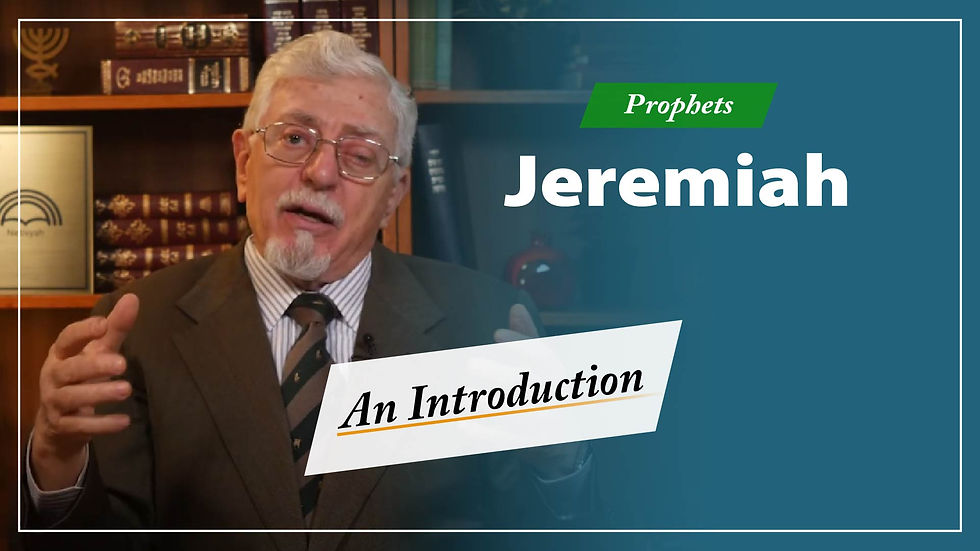
Jeremiah [Part 1] - God's First Love
![Jeremiah [Part 1] - God's First Love](https://static.wixstatic.com/media/421d6e_ca1c3a63d19f4ef6af32c66c8f552df7~mv2.jpg/v1/fill/w_980,h_551,al_c,q_85,usm_0.66_1.00_0.01,enc_avif,quality_auto/Jeremiah%20part%201.jpg)
Table of Contents
Read the transcript below, or watch a video of the teaching by Joseph Shulam.
Shalom. We are studying the book of Jeremiah. We did the first chapter, but I want to repeat it before I jump into the second chapter and say something today about becoming an apostle: every preacher that finished some Bible school in Podunk becomes an apostle, and they become prophets. In Brazil, when somebody became a patriarch, it’s not so easy to become a prophet of God. They didn’t get applause; they didn’t get praise. Jeremiah got beaten. His task was extremely difficult. He was maligned. Isaiah, and his family were ostracized for three years. Amos was thrown out of town, rejected. It’s not such fun becoming a prophet, the messenger of God’s word. Sometimes it is extremely hard, harsh.
Jeremiah is commissioned already from chapter one to do very difficult things. God has chosen him from his youth. God tells him in chapter one, verse 8, “Do not be afraid of their faces", the faces of the opponents, fellow Jews, priests, officials in the government. Don’t be afraid of them.
"Don’t be afraid of their faces, because I’m with you to deliver you,” says the Lord.
But even when the Lord delivers you, it’s still hard. It’s still hard. I have been spit upon in the streets of Jerusalem. I have been beaten in the streets of Jerusalem. I have been bombed in the streets of Jerusalem with hand grenades. A bucket of nails and Molotov cocktails have been thrown into my living room. My car has been damaged. Attempted murder! Hey, it’s not fun to be a prophet of God. Not now and not ever.
So, we did chapter one, and Jeremiah’s commission was in verse 10: "To root out and pull down, to destroy and throw down", and then, after destroying, "to rebuild and to plant". The same message is again repeated in chapter 31, just before God promises a new covenant to Israel and to all those that attach themselves to Israel. And say, after this harsh chapter, chapter 1 of Jeremiah, I’m going to chapter 2.
And there is always God’s grace. God always, in all the prophets, Isaiah, Jeremiah, Ezekiel, all the way down the line, never gives us just bitter herbs, just hot peppers. He never gives us just a jalapeño or a malagueta, very, very spicy, hard-burning pepper. No, he always gives it in a sandwich. The harshness is always sandwiched with the sweetness of God’s grace, all the way from Genesis to Revelation. This principle is held by the Holy Spirit. So, after the harshness of chapter one, we go to chapter two. I’m going to read the first few verses of chapter 2.
Verses 1 to 3 of Jeremiah chapter 2:
"Moreover, the word of the Lord came to me, saying, “Go and cry in the hearing of Jerusalem, saying, ‘Thus says the Lord: I remember the kindness of your youth, the love of your betrothal, when you went following me in the wilderness, in a land that is not sown, (is not agriculturally fitting, desert). Israel was the holiness of the Lord, the first fruits of his increase; and all that devour him will offend, (offend the Lord). Disaster will come upon them,’ says the Lord.”
Very important text. First, it’s a text of grace, of promise, of hope for the future of Israel. Second, there is some revelation here that Christians ignore. God says, “I remember where I married you when you were young.” Talking to Israel. He’s not talking to the Baptists or the Presbyterians or the Methodists or the Catholics or the Seventh-Day Adventists or any one of those Christian sects. He’s talking to Israel, and he says, “I remember you when we got married in the wilderness, in the land that wasn’t sown, (not fit for agriculture).” Verse 3:
"Israel was holiness to the Lord, the first fruits of his increase. All that devour him will offend, (offend God)."
In other words, all the nations that war against Israel, devour Israel, offend God. Not only offend Israel but offend God himself.
This text in Jeremiah has parallels in almost all the prophets. You want Ezekiel? I’ll give you texts in Ezekiel. You want more texts in Jeremiah? I’ll give you. You want parallels in Isaiah? I’ll give you from Isaiah. Israel is the apple of God’s eye, and anybody who touches the apple of God’s eye will reap disaster, and history has proven that to be true. Yes, when Israel sins—boom!—God gives it to us also. It’s already promised in the book of Leviticus, chapter 26 and 27 of Leviticus, and again in Ezekiel and in Deuteronomy. This principle is very clear, and our history proves it, and this is one of the proofs that there is a God in heaven.
Because when we do something that is out of his will, whatever he promised to happen will happen. We had two brothers, ultra-Orthodox Jews, who were members of our congregation, survivors of death camps during World War II, Hungarian by birth. One of them knew the Old Testament and the New Testament by heart, and he used to teach and say, “Everything that the law of Moses says in the book of Leviticus and in the curses in the book of Deuteronomy, everything that was said, is what happened to us in our history in the 20th century, where people had to devour their own babies in order to survive, it happened in the Holocaust times." Praise God, it didn’t happen too often, but it did happen. People ate human flesh in order to survive. Yes, God’s promises and God’s word is a living word, and it is alive, and it happens. But also, the good things happen.
In verse 2, he says, “I remember when we got married in our honeymoon. I took you to the wilderness, and you followed me in the wilderness willingly.” Then the next thing is, “You are the first fruits of the increase; you’re my first love.” There are other texts that correspond to this text also. But when John in the book of Revelation says to one of the churches, “You forgot your first love,” ask the pastors, ask the preachers, ask the professors of Bible in Christian universities, “What is God’s first love?” Who is God’s first love?
Here you’ve got the answer: Israel is God’s first love. The giving of the law in Mount Sinai was the marriage ceremony. There is no marriage ceremony in the Bible without a writing of divorcement. A "k'tubah" in Hebrew, the Torah is our "k'tubah", our contract with God, and we oftentimes in our history didn’t keep our side of the contract. But God had provisional clauses in that contract that even if we sin, he will never reject us.
The text in Jeremiah 31 that says that God will give us a new covenant, that new covenant was not given to the church. It was given to the house of Israel, to the house of Judah. And Christians read Jeremiah 31 from verse 31 to 34, where God is going to write his Torah, his law, in our hearts. He’s not going to write the Nicene Creed in our hearts, or the Ephesus Creed in 475, or other creeds. That the Catholic Church and the Greek Orthodox Church made man-made principles, man-made religion. No, he’s going to write his Torah in our hearts. That’s verse 34.
But if you read 35, 36, 37, you’ll find out that as long as the sun is in the morning, rising up from the east, and it sets down in the west in the evening, and the moon and the stars at night—as long as these witnesses of God exist, God is the God of Israel, and Israel is God’s chosen people, and Israel is God’s inheritance, and He’s ours. Oh yes, I sound like a Zionist. The reason is very plain, because I am a Zionist. I believe in God’s promises to return His children back to Zion, and in Jeremiah, they appear almost every two chapters. You’ve got some mention of God returning his children back to the land that he gave to Abraham, Isaac, and Jacob. Oh yes, sir.
So, the church in the book of Revelation that says—John says—they forgot their first love. The Gentiles in Asia Minor, one of the seven churches of Asia Minor, they forgot their relationship to Israel. They forgot the love of God for Israel. Yes, God punished Israel harshly over centuries. Such things as the Inquisition in Spain and Portugal—that wasn’t cotton candy; that was harsh, bloody, cruel, horribly cruel torture of children, women. You can Google the Inquisition and see the pictures that El Greco painted during the period, and you see what kind of instruments of torture the Christian Church, the Catholic Church, used against mainly Jews, but not only Jews.
Yes, this chapter 2 gives me a lot of comfort, and it ought to give you a lot of comfort. "I remember, God says, The days of your youth, the kindness of your youth, the love of your betrothal when you went following me in the wilderness, in the land not sown. You are my first fruits. You are my increase. And anybody who devours you and hurts you offends me, God says." You think God changed his mind after the cross? No sir, he did not.
And history is rolling on forward, and we are going to see more of the fulfillment of God’s promises to Israel, and also the punishment of the nations that have not repented of their atrocities, their cruelty, their torture, their murder of Jews for nothing, just because they are Jews. Yes, we’re already seeing it, and we see the fulfillment of God’s promises to Israel. Jews have returned home to the land of Israel from 103 different countries. You walk in the streets of Jerusalem; just walk down King George Street or Ben Yehuda Street, you’ll hear probably a dozen languages spoken by Jews. We have black Jews, white Jews, orange Jews, tomato Jews, carrot Jews, whatever Jews you want, we’ve got them. And each one returning back to his house, to his homeland, to the inheritance that God gave to Abraham, Isaac, and Jacob.
The minute he lands, he kisses the ground. You already feel, “This is my home.” I know, I know I was a baby when my parents came here, but I’ve seen others, others from Yemen, from India, even from China, even believers from China and from India and from Yemen and from all over Europe and the great Soviet Union and South America and Brazil. They felt strangers where they were born in their countries, in the language that they spoke. But once they get here, even though they don’t know the language, wow, we’re at home! That’s appeared more than 20 times in the prophets, and in Jeremiah it appears at least eight or nine times. We’re going to see some of it during our study, but this chapter is of great encouragement.
I’m jumping a little bit forward. Verse 4 of chapter 2:
“Hear the word of the Lord, the house of Jacob, all the families of the house of Israel.” Thus says the Lord: “What injustice have your fathers found in me, that they have gone far from me, have followed idols, and have become idolaters? Neither did they say, ‘Where is the Lord who brought us up from the land of Egypt, who led us through the wilderness through a land of deserts and pits, through a land of drought and the shadow of death, through a land that no one crossed and where no one dwelt? I brought you into a bountiful country, (a rich country).’”
The 12 spies that Moses sent to spy out the land in the book of Numbers, chapter 13, come back. And the picture that the Torah gives us is that the bunch of grapes that they carried—two men had to carry the bunch, it was so big, so fertile. The land was fertile, the land is fertile today more than ever. If you’re eating cherry tomatoes, red ones, yellow ones, blue ones, green ones, anywhere in the world, you should know they were developed in the town of Rechovot, the town that is mentioned in Egyptian annals from the fourth millennium BC. Yes, on the Via Maris, on the way of the sea that led the traffic from Egypt to Damascus and from Damascus to Mesopotamia, from Mesopotamia to Asia and to Europe, developed here. If you’re wearing glasses like mine that, in the sunlight, become dark, you should know it was developed in the Galilee, in Kibbutz Amir, right underneath Mount Hermon. If you’re using Waze to guide you through the streets of Kuala Lumpur or London or New York or Nashville, Tennessee, you should know it was developed by high school students in Israel. I could keep on saying, because God is keeping his promises. That’s the greatness of our study in God’s word.
There is a myth—I don’t know if it’s a myth or a fact—that the Tsar of Russia called his priest Rasputin—not such a nice guy, not such an honest guy, but it was the royal priest—and said, “Rasputin, you know I have some doubts in my mind. Can you give me a proof that God really exists?” Rasputin said, “Let me think about it till tomorrow. I’ll bring you a proof.” Okay. The next day Rasputin comes to the king. Oh, the king asked him to give it in one sentence. Rasputin comes back the next day. “I said I can give it to you in one word: the proof that God exists is the word Israel. The nation of Israel, the Jews, are proof that God exists because he promised them thousands of years ago what he’s going to do with them, and he kept the harsh things and the punishments, but also the blessings that he promised them. That’s the proof that God exists.”
With this, my dear brothers and sisters, I will end this lesson. And from here, I want to jump quite a distance and bring Jerusalem and the Messiah into the picture. So, God bless you, and we’ll continue to the next lesson in the book of Jeremiah. Shalom from Jerusalem.
Get Downloads
File Title
Add paragraph text. Click “Edit Text” to update the font, size and more. To change and reuse text themes, go to Site Styles.
Add paragraph text. Click “Edit Text” to update the font, size and more. To change and reuse text themes, go to Site Styles.

Joseph Shulam
Founder
Joseph is the pioneering founder of Netivyah, one of Israel’s first official Messianic non-profits. Dedicated to restoring the Jewish roots of the faith, he has authored numerous books and lectured globally for over 50 years.
Glossary
Covenant (brit, בְּרִית) means a sacred agreement or bond between parties, such as between God and His people.
Holiness (kedushah, קְדֻשָּׁה) means being pure, set apart, and living according to God's will as He instructed in His Word
Shalom (שָׁלוֹם) means peace and completeness, and is often used as a greeting in Israel, both when meeting and parting.
Torah (תּוֹרָה) means “instruction” or “teaching” and often refers especially to the Five Books of Moses. Psalm 119:1 reminds us that those who walk in God's Torah are blessed.
More Topics
More For You

Shabbat Nachamu: Comfort for Israel, Hope for Jerusalem, and the Nations’ Prophetic Calling
Shabbat Nachamu calls the nations to comfort Israel, stand with Jerusalem, and prepare the way for God’s promised restoration.
Article

Jeremiah [Part 2] - Jerusalem, Capital of all Believers
Jeremiah presents Jerusalem as the capital of all believers, calling Israel and the nations to repent, circumcise the heart, and seek God’s peace.
Video