Isaiah - An Introduction

Table of Contents
Read the transcript below, or watch a video of the teaching by Joseph Shulam.
Shalom. In partnership with Brad TV, we are doing a series on the prophets. We did several teachings on the 12 Minor Prophets, and now we are jumping into the deep waters. We're entering into the prophet Isaiah, which is one of the largest books of the prophets – 66 chapters. Normally, scholars divide the book of Isaiah into Isaiah 1 and Isaiah 2.
Isaiah 1 is from chapter 1 to chapter 39, and Isaiah 2 is from chapter 40 to chapter 66. Some even divide it into three parts: part one Isaiah 1 to chapter 39, Isaiah 2 from chapter 40 to chapter 55, Isaiah 3 from chapter 56 to 66. But I'm a graduate, studied at the Hebrew University in biblical archaeology and Bible, and there were professors who held this Western view, and others who didn't. I belonged to the school that says no, not in any way are there three different Isaiahs.
There's one Isaiah. And if you believe in prophecy at all, meaning that you believe that God gave revelation to His servants, the prophets, and that revelation spans could span over thousands of years, and we are experiencing this in the 20th century, that events that are taking place in Israel now, today, and yesterday, and a hundred years ago are predicted by prophets who lived in the 8th century BC, like Isaiah, then you have to believe that God, who created the Heavens and the Earth, knew ahead of time the program of what is going to happen and how things are going to develop and how His choice of Abraham, Isaac, and Jacob is going to function throughout history all the way to the end of history, to the new heavens and the new Earth, which is in Isaiah and in the Book of Revelation in the New Testament.
So, if you believe in a God that is the father of all mankind, the master of history, the creator of the heavens and the Earth, there is no reason for you to believe that there are three different Isaiahs. Oh yes, there are differences in style, in vocabulary; there are differences in content, but they're friends and brothers. If you read literature that was written in the early days of Shakespeare and then read Shakespeare toward the end of his life, you will see differences.
If you read any writer that wrote over many years, let's say over 30 years, then you are going to see a development in his style, in his language, in his vocabulary, and he will adjust himself to the style and vocabulary and cultural changes that occur in any nation, in any language, in any culture over decades of years.
So, I personally don't see any reason because of stylistic differences and content differences and vocabulary differences to say that there were three different Isaiahs who wrote and their names were maybe not Isaiah, maybe they're Bartholomew and Cassidy wrote and somebody took these books and sewed them together into one 66-chapter long Isaiah. Alright, I don't believe it. I believe that we have one Isaiah, and the same Isaiah wrote from chapter 1 to chapter 66, and he had revelation, prophetic revelation, and he expressed that revelation as he grew older and his style and vocabulary and cultural setting changed. Not needed to be a genius to understand this, it's simpler to understand it than to invent three Isaiahs that I believe didn't exist.
Only one Isaiah existed. So, that's an introduction to the introduction of the book of Isaiah, addressing one of the major academic discussions in the last 50 years, 60 years on Isaiah. So, we got over that one and remained alive, and we don't have to get back to it at all. Now, another thing about Isaiah is that in the book of Isaiah, from chapter 1 to chapter 66, there are so many Messianic prophecies.
In chapter 53 of Isaiah, there are around 30 Messianic prophecies in one chapter. And I can say it without any doubt that there is only one person in history who has fulfilled these prophecies in Isaiah, and that is Yeshua, Son of God, the Messiah that lived and died on the cross and resurrected after three days and is sitting at the right hand of God right now. He's the only one that even comes close to the fulfillment of these prophecies in Isaiah.
It's very important because in the history of Judaism, we have at least a dozen false Messiahs, men of power, men of popularity, powerful characters, medieval characters that claimed to be the Messiah, and every one of them turned out to be a false Messiah, and none of them fulfilled even one percent of what Yeshua fulfilled in Isaiah alone, not to speak about the Torah and the other prophets. Now, Isaiah is not necessarily a prophet that we could say a Messianic prophet, that the Messiah is that the head of his interests.
No, the main thing that interests and addressed by Isaiah in his prophecy was the political situation of his day, not only the politics within Israel but the politics with the nations around Israel, the neighbors, the far neighbors like Babylon and the closer neighbors like Edom and Moab, the neighbors on the other side of the Jordan River. Now, Isaiah opens with the names of the kings during whose reign he prophesied, and we can calculate how many years he prophesied.
And it's a long time, it's almost a lifetime. One more thing as an introduction of Isaiah: he is a classical prophet. By a classical prophet, we mean a prophet that didn't have a private jet plane and a fancy car that's worth a million dollars. And he wasn't accepted by society. He was a classical prophet because, first of all, he wrote his prophecies.
Second of all, he was persecuted, rejected, ostracized – socially ostracized, politically ostracized by the establishment, both the political establishment and the priestly establishment in the temple in Jerusalem. And he is prophesying in chapter 1 to 39 about the political reality of Israel. Chapter 40, he starts these prophetic utterances that deal with the future of Israel. And then he goes into the Messianic prophecies in chapter 49 of Isaiah, and that continues to chapter 63 and on to the end of Isaiah.
His language is very sharp and very critical of the political establishment and the religious establishment and of the temple itself and the temple worship. And that's what made him not popular. He didn't write and he didn't say in the streets of Jerusalem the things that the people wanted to hear. Most of the classical prophets didn't say what people wanted to hear. They said what God wanted them to say and delivered to them and inspired them and enlightened them to speak in His name.
So, when you're speaking in God's name, oftentimes you're not going to be popular because sometimes God, like a good father, has to reprimand, has to correct, has to be angry at His children that betray Him, that ignore Him, that misuse His name. You know, you can be very religious, and Isaiah chapter 1 starts with this, you could be very religious and very, very far from God. You could keep the holidays, go to the temple, offer sacrifices, celebrate, worship, and be totally far, far from God. Religion – and I would say all religions – don't bring you closer to God. Faith does, love does, trusting God does, hoping in God's promises – that brings you closer to God. But religion doesn't – depends how you define religion, by the way.
One more thing as an introduction, as I said, Isaiah has bulk of political prophecies about Israel – Israel's sins, Israel's misuse of God and His law, His Torah, and also prophecies about the nations. There's only one prophet in Israel of the classical prophets in the Bible that doesn't prophesy about the nations. But most of the prophets are not exclusive prophetical professionals only about Israel because Israel is embedded in the context of the tail end of the Levant. The Levant is from the Persian Gulf along the rivers Tigris and Euphrates, the Fertile Crescent, then through Syria, Lebanon, all the way to the Egyptian border and our prophets in the Bible, the classical prophets for sure, prophesied about the whole Middle East situation because the God of Israel is not the God of Israel alone – is the God of all the world.
And He cares about the Babylonians and the Assyrians and the Ammonites and the Moabites and the Egyptians. And we see in all the classical prophets an addressing of the whole Middle East. Isaiah is no exception. That's important to remember. The second thing of introduction is that from the very beginning of Isaiah, he minimizes the value of worship in the temple in comparison to the value of having a relationship – a faithful, faith-based, honest-based relationship with God.
But where God is at the top of the triangle and at the bottom a wide bottom of the triangle are you and your fellow men or you and Israel or you and the nations around you – the political context, the social context, the economical context of the world in which you live.
For Isaiah, like Jeremiah and Amos and other of the prophets and like with Jesus himself, the way to have a relationship with God is to have a godly, honest, loving, respectful, socially sensitive relationship with your neighbors, with your fellow men, with the people around you. You can't reach God directly. The only way you can reach God is through your relationship with other people. Jesus taught the same thing in the gospel.
The people came to him, he said, "I was hungry and you didn't feed me, I was naked and you didn't clothe me, out homeless and you didn't provide anything for me." I'm broadening the context into a more modern setting and the people said, his disciples said, "When did we do that? When we neglected you when we were hungry and we didn't feed you, when you were thirsty and we didn't give you the drink, when you were naked we didn't clothe you?" He said, "As much as you did it to one of the least of these people, the poorest people, the less important people, you did it unto me."
That same paradigm is based on Isaiah, Jeremiah, Ezekiel, Hosea, Joel, Amos, all the prophets, all the classical prophets. It's an important point to remember in the introduction. Another one important point to remember is the role of the Messianic prophecies in all the prophets.
But since Isaiah is the biggest one, I'm bringing it to you now. What was the purpose of the prophecies and especially the Messianic prophecies? In my opinion, the purpose of the Messianic prophecies that were prophesied hundreds of years before the birth of Yeshua in Bethlehem before the shepherds, as the star, based on the Torah – Yeah, a star from Jacob will shine, will rise before the Magi. So they start and followed it to Bethlehem.
The purpose of the Messianic prophecies is, above all, encouragement in time of trouble, in time of depression, spiritual depression, in time of sins of the prophets, false prophets, and of the priests and of the politicians, when people are not walking in the light and not doing God's will. The prophet says that they will come in which unto us a child is born and to us the son is given and his name will be Wonderful Counselor, Prince of Peace, Everlasting Father. Isaiah 9.
The politicians now are not walking with the Torah, not walking with God and His words, and they persecute the prophets. But I'm telling you, the time is going to come, this is going to change, God is going to have his messenger, his Messiah change the course of history. Oh, that's a hard statement for me to make because when I look at Christianity in general, I see changes but they're not the changes that God intended the world to have.
The church in general, from the Catholic to the Greek Russian Orthodox to the Protestant churches, are not exactly the candle that is to be the light of the world. Yes, Jesus is hanging on the cross in the churches, especially Catholic and Greek Orthodox churches, and Ethiopian churches and Armenian churches. But not only, also in some Protestant churches, usually it's crosses are empty in the Protestant churches.
But my dear brothers and sisters, I pray for a restoration of the early church, of the teaching of Jesus, of the love that God has demonstrated for us at the human race when He sent His only begotten son so that nobody will perish but that everybody can have everlasting life, the good life everlasting. So this is my introduction, very general introduction to the prophet Isaiah, and my suggestion is to start reading, read at least till chapter 10 and be prepared for the next teaching, Isaiah chapter 1 onward.
Get Downloads
File Title
Add paragraph text. Click “Edit Text” to update the font, size and more. To change and reuse text themes, go to Site Styles.
Add paragraph text. Click “Edit Text” to update the font, size and more. To change and reuse text themes, go to Site Styles.

Joseph Shulam
Founder
Joseph is the pioneering founder of Netivyah, one of Israel’s first official Messianic non-profits. Dedicated to restoring the Jewish roots of the faith, he has authored numerous books and lectured globally for over 50 years.
Glossary
Baraita (בָּרַיְתָא) means “outside” and refers to teachings from the period of the Mishnah that were not included in the Mishnah itself but are frequently cited and discussed in the Talmud.
Baraita (בָּרַיְתָא) means “outside” and refers to teachings from the period of the Mishnah that were not included in the Mishnah itself but are frequently cited and discussed in the Talmud.
Baraita (בָּרַיְתָא) means “outside” and refers to teachings from the period of the Mishnah that were not included in the Mishnah itself but are frequently cited and discussed in the Talmud.
More Topics
More For You

Isaiah [Part 1] - God's View on Worship
God’s view on worship confronts empty ritual: Isaiah declares that sacrifices mean nothing without justice, clean hands, and lives shaped by faith.
Video
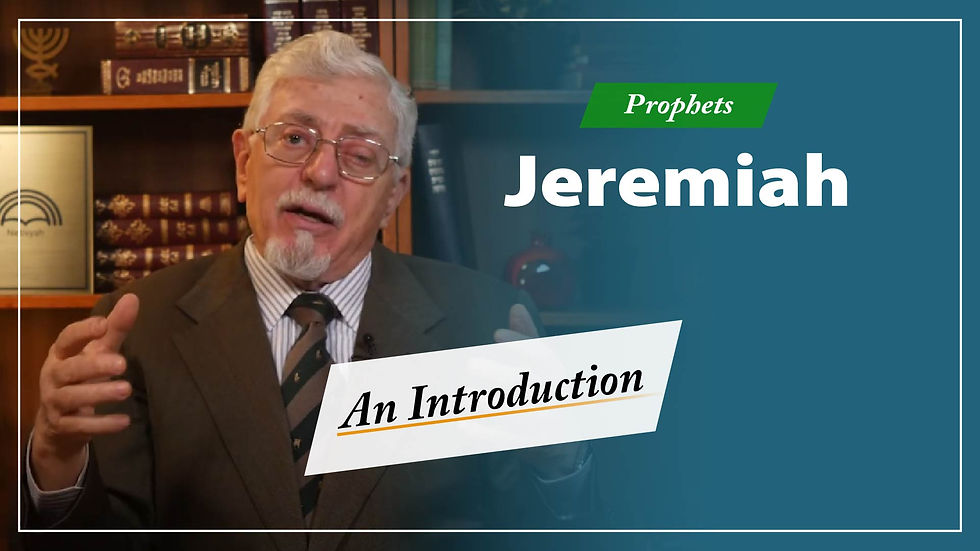
Jeremiah - An Introduction
Explore Jeremiah's calling, struggles, and faith as we uncover timeless lessons of courage and obedience in this powerful prophet's journey.
Video
