Jeremiah - An Introduction
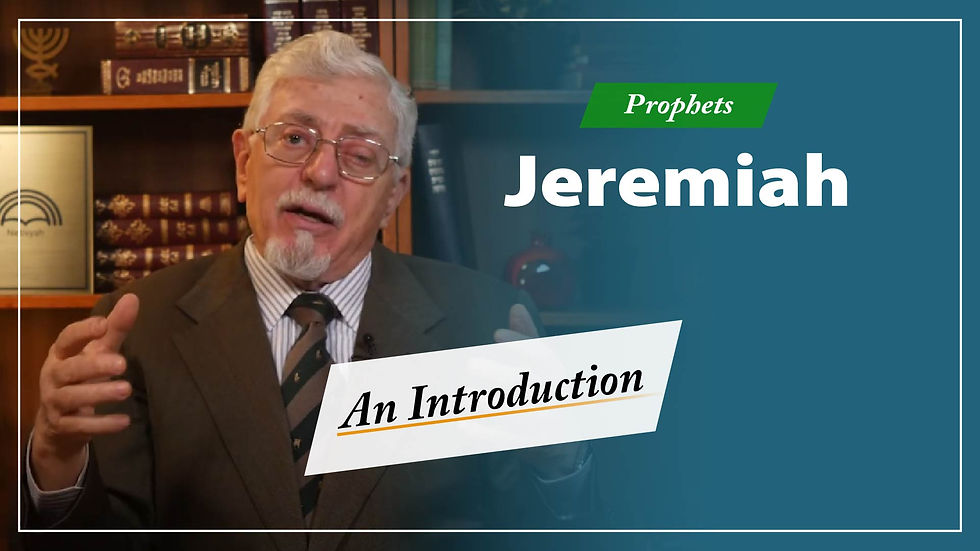
Table of Contents
Read the transcript below, or watch a video of the teaching by Joseph Shulam.
Shalom. In partnership with Brad TV, we've been doing commentaries on the five books of Moses, and we finished that. Then we did on the 12 Minor Prophets, and we finished that. Then we did on Isaiah, and we just finished that. Now we are entering into the prophet Jeremiah's text from the book of Jeremiah.
Jeremiah was a very interesting character, and his mission is very interesting. His commission is very interesting, and we are going to face this challenge with prayer. Like John Calvin prayed when he started doing the commentary on Jeremiah, a prayer that asked God for strength, and for guidance, and for leisure—a time to be able to write his commentary in Jeremiah. In the early 5th Century, Jerome, the great Bible translator and commentator and scholar that lived most of his life in Bethlehem, actually in the Old Church of the Nativity, never finished his commentary. He worked for, several years, and accomplished in two years of full-time work. He accomplished writing a commentary on Jeremiah from chapter one to chapter 32. About two-thirds of the book of Jeremiah, never finished it. One of the reasons that Jerome didn't finish is because his library burned, and that kind of discouraged him enough not to finish his commentary on Jeremiah.
So, let me jump in to discuss Jeremiah. He was a priest—a Hebrew Jewish priest. That means that he had a commission to serve in the temple if he wanted to. He lived in Anatot, just over the Mount of Olives, on the other side of the Mount of Olives, Anatot, in the land of Benjamin. Now, he starts his prophecy in chapter 1, verse 1. Or the editor starts Jeremiah's prophecy in chapter 1, verse 1, because it's in third person, speaking in Hebrew in third person:
"The words of Jeremiah, the son of Hilkiah, of the priests who were in Anathoth in the land of Benjamin, to whom the word of the Lord came in the days of Josiah, the son of Ammon, king of Judah, in the 13th year of Josiah's reign. It came also in the days of Jehoiakim, the son of Josiah, king of Judah, until the end of the 11th year of Zedekiah, the son of Josiah, king of Judah, until the carrying away of Jerusalem captive in the fifth month."
That is the editorial comment in the opening of The Book of Jeremiah.
How do I know it is the editorial comment? Because in verse 4, we change the speaker. Jeremiah is spoken of in the third person from verses 1 to 3, and from verse 4, we have Jeremiah speaking about himself.
"Then the word of the Lord came to me, saying..."
—came to me, not came to him—'came to me, saying':
"Behold, I formed you in the womb; I knew you before you were born. I sanctified you; I ordained you a prophet to the Gentiles, (to the Nations)."
Let me stop here. Uh, this is unusual because all the other prophets prophesied about the Nations as well, except Obadiah, which is a very short one chapter. He talked about the Nations as well, but he didn't prophesy to the Nations. But Jeremiah is actually commissioned by God to be a prophet, that his prophecy is directed, addressed to the Nations, although not only to the Nations but also to Israel, and we're going to see it.
Now that's important for us to think about. We talk about the Old Testament, the Hebrew Bible, as a product designed for the nation of Israel because the God of Abraham, Isaac, and Jacob, the God of Israel, who has chosen Israel as His pride and His possession, private possession, His treasure, the apple of His eye. We think that God has somehow put the Nations on another level. But I propose to you that Jeremiah is commissioned to be a prophet to the Nations, but not only to the Nations, also to Israel, because Israel is a nation also, and as a nation chosen by God. And we're going to see that in the next chapter—chapter 2—very clearly, in a very important way.
But the concept that God can choose somebody from the womb, from before he was born, and have a destiny set for him, his job, his calling, his mission, before he was born, is a little bit of a difficult concept to digest. Because the impression that we have from John Calvin and those that followed him is that we are predestined. Our lives are predestined. Our destiny has been set ahead of time, like the text in Jeremiah says.
And we are going to see this further down in Jeremiah that we can't understand it in the classical concept of predestination. Yes, God knows all of us before we are born. Yes, God determines a lot of our lives before we are born, or every one of us. He determines who is going to give us life, birth, who our father and mother is going to be. We didn't choose them. He determines what kind of gene pool we're going to inherit. We didn't choose that either. Not the color of our hair, not where we're born, not where we are raised as children, not how tall we're going to be, not how smart we're going to be. A lot of the cards that we have to deal with in life are given to us without asking us our opinion and without asking us what we would choose.
God hands it to us—all of us. That doesn't mean that we don't have any free will. It means that God metes out the tools: the gene pool, our height, our health, our color of our hair, are we going to have hair or not have hair. All of these things are given to us. But still, I believe in Judaism, and the Jewish nation, and the Jewish history, and the Jewish understanding of life and Bible, is that we still have a lot—and especially all of our relationship to God is based on a free will.
Yes, the cards are handed to us to play with them throughout our life, but our relationship to God is not predestined. This is at least the traditional Jewish ancient viewpoint that is still valid. In Hebrew, he said, I'm translating for you, 'everything is set ahead of us except our fear of the Lord'. That is not set. Our relationship to God, our faith in God, our destiny in this relationship with God is not set. But where we're born, the color of our hair, who our parents are, what nationality we're going to have, what skin color we're going to have—all these things are set by God. Except our relationship to God Himself, that is the only real, authentic free choice that we have, and that is a choice that we must make freely.
Now, the English translations oftentimes, like all translations, miss a lot. Because both verse 1 of Jeremiah and verse 4 of Jeremiah start with the words: "The words of Jeremiah, the son of Hilkiah," or "The words of the Lord that came to Jeremiah." Dear brothers, Hebrew is a very small language, very small vocabulary. I don't know the number of words in the Japanese dictionaries, but I know that Biblical Hebrew has very, very few words—around 23,000 words. The Webster Dictionary of the English language has 500,000 words. So, a lot of times words have double meaning. For example, the word in Hebrew for words, "divrei" (davar), the root "davar" in Hebrew, has so many meanings. "Davar" could be a word, it could be a thing, it can be an event. Yeah, it has many meanings.
And I think that the way we need to read this text, in Hebrew, is the words and the deeds—the things which Jeremiah, the son of Hilkiah, has done. And it starts with this interesting thing. In verse 4, 'before I formed you', God tells Jeremiah,
"...before I formed you in the womb, I knew you, before you were born. I sanctified you; I ordained you a prophet to the Nations."
Now, I want to kind of deviate a little bit on this issue. None of us, not any human being, and in my opinion, not any animal, is an accident that happened in history. All of us are designed specifically according to the great designer—the God, the Father of all mankind, the God of Abraham, Isaac, and Jacob. So I don't believe that only Jeremiah was formed by God. I believe that every human being was formed by God.
There is an element of—not Calvinistic predestination, but there is an element of predestination in our lives, in our birth, who our parents are, where we were born, how we were raised, how much hair we're going to have on our head when we grow up. All these things are given to us. And, of course, free will is given to us by the almighty God. We have choices to make. If we follow the biblical text and see how many times God tells to choose—'choose life!' in Deuteronomy, yeah, choose. Jeremiah had to choose. Elijah the prophet had to choose. He gave Israel the choice: "You are jumping between two branches," he says. "Choose which one you want to serve. You want to serve the idols, or you want to serve God?"
Yeshua (Jesus) gives us choices. He said there are two roads: an easy road that goes downhill, and in fact, there's grease, so you could slide down it quickly and easier; or a very hard road that goes uphill, but it reaches to Heaven, to salvation, and not to damnation. Our life is made up of choices, but the cards, the tools that we need in order to make the righteous and the good and the smart and the wise choices—they are handed down to us. They're given to us, and we have to make the choices. Yes, we have to make the choices. So, God said to Jeremiah,
"I chose you before you were born. I sanctified you."
In other words, "I commissioned you. I prepared you for a certain job, for a certain mission.
"I ordained you to be a prophet to the Nations."
Jeremiah responds to God. It's important for us, as an introduction to the prophecies of Jeremiah, to understand the dynamics of what God wants from Jeremiah and Jeremiah's own attitudes and fears to receive from God his commission. Jeremiah answers God:
O Lord God, behold, I cannot speak; I am a youth.
'I am a young man. I can't take that job.' I realize, Jeremiah would say, that you designed me for this job before my birth, but I don't feel confident, and I am only a young man. I don't feel secure enough. Now remember that Moses had some similar problems. He told God, "I can't do the job. I can't speak right. I am stuttering, and I can't speak the way that you would want me to speak." And God told him, "Listen, I made your mouth. I know exactly what you can or can't do." Jeremiah, the same thing. God answered Jeremiah when he says, "I am a youth, I'm just a young man, and I can't speak." In verse 6 of chapter one, God answers him:
"For you shall go to all to whom I send you, and whatever I command you, you shall speak. Do not be afraid of their faces, for I am with you to deliver you," says the Lord.
I suppose that everyone that feels commissioned by God to be a prophet, to be a deliverer, like Moses, feels the same thing. I say that I started teaching the word of God and preaching the word of God and evangelizing at a very young age, even 16, as soon as I became a believer and a disciple of Yeshua. And I've been doing it now for more than 60-some years all over the world. Right now, even though I'm retired, I'm teaching in Zimbabwe, in Papua, in Finland, in Bulgaria, in the United States, in Brazil, in Taiwan, in China, in Japan—almost every week now, not physically, but on Zoom.
Of course, we have the coronavirus, thanks to the Chinese, but we also have the solution to the coronavirus, thanks to the Chinese. They gave us Zoom about the same time that they gave us the coronavirus. So, yes, I continue to teach and preach and evangelize and guide and direct people from all over the world. But God says, "I designed you before you were born for this job. Don't give me any excuse. You are going to do whatever I tell you to do, and you're going to speak whatever I give you to speak. I command you, you shall speak."
Now, I want to stop here in a minute with this idea. I don't know if every human being's destiny is set the way Jeremiah's was, the way Elijah's was, the way Moses's was, the way Jesus's was. I don't know. But I know this: that when God puts His finger on you and points at you and says, "This is what you have to do," running away won't help you. Running away won't help you. Dear brothers and sisters, Jeremiah had a rough life; he was persecuted. Isaiah had a rough life; he was persecuted. All the prophets had a hard life—socially, spiritually, sometimes also physically. But they had to do what God had appointed them to do.
And trying to run away, like Samson did in the end, makes your life more miserable, more difficult, more challenging. But in the end, like Samson, you are going to get the job that God appointed you to do done. You will do it, but your circumstances are not going to be as easy and so happy as if you submit to God and receive what He gives you and put it to work. Put your life in His hands. Put your hand in the hand of that lonely Prophet, Son of God, Messiah, divine revelation of God in the flesh, Yeshua.
Receive the commission that God has intended to give you, and don't fight back. Say, "Thank you, Lord. Whatever you want me to do, whatever you want me to have, whatever you want me to say, whatever you want me to submit to, I am here—hineni." Like Abraham said, "hineni," and Isaac said, "hineni," and Jacob said, "hineni," and King David said, "hineni." "Hineni" means, "Lord, I am here, ready to do whatever you commissioned me to do." Yes. May God bless you and me, and let's learn Jeremiah together in the subsequent weeks. In Yeshua's name, thank you, Lord, for the opportunity to study and to share Your word with people around the world.
Get Downloads
File Title
Add paragraph text. Click “Edit Text” to update the font, size and more. To change and reuse text themes, go to Site Styles.
Add paragraph text. Click “Edit Text” to update the font, size and more. To change and reuse text themes, go to Site Styles.

Joseph Shulam
Founder
Joseph is the pioneering founder of Netivyah, one of Israel’s first official Messianic non-profits. Dedicated to restoring the Jewish roots of the faith, he has authored numerous books and lectured globally for over 50 years.
Glossary
Shalom (שָׁלוֹם) means peace and completeness, and is often used as a greeting in Israel, both when meeting and parting.
Yeshua (יֵשׁוּעַ) is the Hebrew name of Jesus, meaning "salvation"
More Topics
More For You

Isaiah - An Introduction
Introduction to Isaiah: one prophet, not three. One lifetime of revelation, confronting power, calling faith over empty religion, and pointing to the Messiah.
Video

Jeremiah [Part 1] - God's First Love
God's first love: Jeremiah shows prophecy brings pain, not applause, yet judgment is wrapped in grace and God’s covenant with Israel never changes.
Video
